Back when my blog had just a few visitors (only nine months ago), I wrote about ARForce. In a nutshell, ARForce is a concept input device that harness infrared to create something akin to a 3d multitouch marker.
Luckily, Tokyo University, which is behind ARForce, has just uploaded a new video demoing the use of ARForce is several scenarios, so this cool concept will gain larger exposure:
The following video tells it all (but I'll write a short blurb to justify my non-existent salary). ARForce is a sensor coming from the university of Tokyo, that can tell the position, magnitude and direction of the force applied to it by the user. It also has multi-touch capabilities. ARForce is embedded with an array of dots, visible under infrared light and a camera. When pressed, the dots slightly realign, enabling the calculation of the pressure vector. Different initial arrangements of the dots can identify different input devices.
Though such a device is not strictly related to AR (apart from its name, and the demo presented above), it does show the viability of infrared markers, at least for indoors AR. Any thoughts on the subject?
Previously I blogged about a short Youtube video, demoing a project at Beijing Institute of Technology. The project uses infrared markers for augmented reality in maintenance tasks. Few days ago I found this paper describing the project in more detail than provided in its Youtube page. Here again is the video clip:
Basically, they use an infrared projector in order to project (the surprise!) a number of infrared dots (usually 6 of them) on some object, serving as a marker. The hand held device is composed of two cameras, one scenic, and another infrared one. The IR camera is looking for the projected dots, and calculates the distances between them. The device calculates using those distances the alignment and position of the augmented object, and thus can annotate images taken by the scenic camera. Which is pretty cool. The obvious downsides of this method is the use of two cameras (though, I don't think it's impossible to combine them both into one), and the limited number of markers. Unlike the visual makers we all learned to hate, with their many white and black bits, with the IR markers, one cannot simply rearrange the "dots" in order to get a new marker, since the dots' positions determine the direction of the object. Maybe adding few more dots to the jumble can relieve this problem. Another major problem with this technique is that a projector can only mark a limited number of objects, so if we wanted to implement this method in order to augment museum items, we would need numerous projectors.
Wang, Liu, Wang, Infrared Marker Based Augmented Reality System for Equipment Maintenance, International Conference on Computer Science and Software Engineering, 2008
There's not much that I can say about it, a project done at Beijing Institute of Technology harness the ability of cameras to see infrared light in order to augment an industrial environment. The following (subtitled) video demonstrates using this method for maintenance tasks.
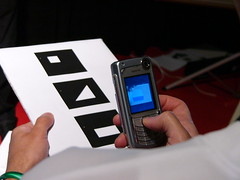
Tags (also known as markers) are the easiest way to augment the real world. Usually in the form of black and white squares, tags serve as an easily identified (from a computer vision point of view) visual queue. No wonder this method is so popular among amateurs and students. However, tags are ugly. Augmented reality cannot really hit mainstream if it keeps on using the computer-friendly but eye-sore inducing tags. Thus, a lot of research was done on how we can make the tags less obtrusive or even on to get rid of them completely. Here's a collection of some of the methods developed by those smart Graz students:
Alas, having unobtrusive tags is computationally more expensive - it takes longer, and on mobile devices may drain your battery quicker. Is there a better option? How about tags that are clearly visible to the computer but nearly invisible to human eyes? Here's a fun experiment - take your camera phone and look through its camera while pressing a TV remote. You should then be able to see its IR signal - that is, your phone (or rather most camera phones) is able to see infra red light. On the other end of the spectrum (that is, the visible spectrum) is ultra violet. Here's a fluff story about a boy who made an invisible sticker (for humans) warning birds (apparently birds can see UV light) of birds. Can we adapt the same technology for augmented reality?
We, at Augmented Times, believe that augmented reality (AR) is the next big paradigm shift. Connecting the world wide web with the physical world and the many objects, places and humans it contains, AR is both a disruptive technology and an exciting vision of the future.
This blog's goal is to document AR taking over our lives, but it needs your help. Have an augmented reality related news or story? Published an interesting paper about AR? Have something to say about this site or the AR community in genereal? Tell us about it, at rouli.net ~at~ gmail.com

 Subscribe
 Follow
