A few months ago Ralph Osterhout had a chance to present his vision for the future of HUDs at the e.g. conference. If you had to some his vision into one word it would be amazing. The list of features is endless, from night vision to high definition 3d display. Even more amazing, Osterhout claims that a militarized version of this HUD would be available this summer, and a consumer product will come "sooner than what you may think".
Osterhout is far from a quack, but I'll believe it when I see it. In the meantime, if you consider yourself a fan of AR, you must watch the following talk (and share what you think about it in the comments!)
Imagine for a moment how would it be like to replace your sense of vision with the point cloud generated by Kinect, which in turn is controlled by your arduino glove. Thanks to designer Maxence Parache you don't need to imagine such a scenario anymore
I'm not sure if this project can be catalogued as augmented reality, and if so, it is surely on the fringes of AR (since it seems to me to increase the latency between atoms and bits). Is the term alternative reality taken yet?
via Yanko Design (where you can see some more videos)
There are a few topics that I've been planning to write about for months (if not years). One of them is the role sports enthusiasts (joggers, swimmers, bicycles fanatics) may have in the adoption of augmented reality head up displays. The recent onslaught of hi-tech skigoggles was the push I needed to finally do something about it.
Instead of writing a long post (which many won't read), I'm trying something new here. I've created a short presentation with only a few words that describes my views. I would be very happy to hear your comments on this format. If you like it, I'll create more presentations on other subjects.
I'm a firm believer that the first commercially available head up devices will be sold to joggers and bicyclists.
Imagine going on an augmented run, where instead of just listening to music or podcast, you do that, and play a computer game for the extra motivation. Every now and then you'll have to pick a virtual coin, or avoid some virtual danger. Think of Sonic the Hedgehog, where you are Sonic. Or you may run against a virtual competitor, which may very well be non other than yourself, as recorded on a previous run. At the very least you'll be able to constantly see you heart rate and the number of miles you've already completed.
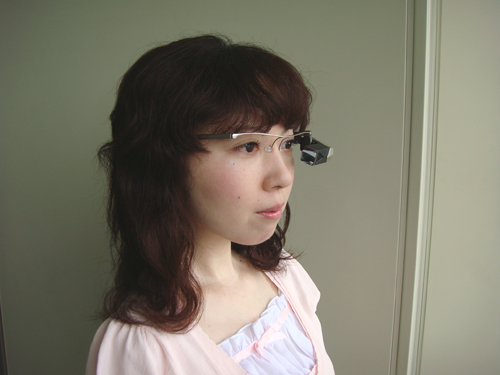
Now meet AR Walker from Olympus. It's a simple HUD (and not available commercially), but it's a good start. Once AR takes hold among amateur sportsmen, it will have a real chance in entering our daily lives.
SIGGRAPH, the world's most important conference on computer graphics and a pixel-fetishist wonderland is being held this week in Los Angeles, featuring several interesting papers on augmented reality. One of them explores the augmentation of cookies.
Yes, we have all seen cookies marked with augmented reality markers. Games Alfresco has mentioned such cookies back in 2008. So how come such a paper got accepted into SIGGRAPH? Well, the simple answer is that you've haven't seen (or rather tasted) such cookies before.
Created by researchers at the University of Tokyo, Meta Cookie combines together a head up visual display and head up olfactory display to trick your senses. I'm not quite sure what was the goal of that research, but were successful in changing how the cookie tasted. Probably some smart marketer will find a way to sell it as a weight loss device. You just need a way to print a marker on broccoli to make it tastes (and look like) ice cream (with a crunchy texture).
Addicted to Farmville? Have a green thumb but no garden? Envy real farmers but got allergies? The guys from TU Munich have the perfect solution for you:
Augmented Farmville could be one heck of a layer for Layar/Junaio/Wikitude once better positioning is available. Think of the gold rush to get a virtual plot in major cities, imagine Times Square as a flower bed! Using real meteorological data to those virtual farms would add another interesting and educational twist. It may be the most stupid idea I have ever featured in this blog, but then again, nobody would guess that a farm simulator will be one of the most successful games in 2010.
AgroTech, a Danish institute that provides consultancy and technological services for the agricultural industry, has created a rather interesting conceptual video, showing AR in an unconventional niche. The video below shows a farmer running a farm (milking cows, moving manor) aided by a pair of AR glasses. Though the text bubble are in Danish, you'll probably understand the jist of things
You're probably wondering what's the last bubble says. It's "Remember wedding anniversary tomorrow". So there you have it, a single system that reminds you when to milk your cow and when to buy a gift to your wife. Perfect!
Take a nice girl. Make her don various head mounted displays. There, you've just invented a new fetish. Did I say the girl speaks only Japanese?
Filmed at SIGGRAPH Asia 2009 that ended today, the video below shows various AR and VR applications using head mounted displays. The reporter from ASCII magazine slays virtual samurai warriors in a game named Kaidan by Ritsumeikan University, draws with virtual ink on plates and plays with Franz Lasorne's war game.
Cool NEC is developing a head mounted display named Tele Scouter which it hopes to begin shipping somewhere in 2010. The eyepiece shown in the image below has some really neat features like front facing camera and eye tracker. This enables a remote server to see whatever you're looking at, and send you some relevant content to be displayed on the little screen. Not so cool- it's going to cost a small fortune, and NEC is only planning to sell about 1000 of those in the next three years. More details on SlashGear.
Cooler Fellow Japanese company, Brother Industries is not left behind. Apparently they developed a light-weight HMD (by light-weight I mean 350 grams including batteries) that should also hit the stores in 2010. Like in Tele Scout's case this unnamed HMD superimposes the image it generates over reality, not blocking the user's view. So why is it cooler than NEC's device? Well, they use terms like "green diode lasers", and if that doesn't make you blind, it's surely very cool. More details on TechOn.
Coolest Now you can make a HMD right in your own home (though you'll need an iPhone and some cardboard):
Though none of those devices (certainly not the last one :)) is aimed for the AR crowd, I guess that enthusiasts will find way to harness them for cool demos. Don't forget to read Tom's review of more concrete offerings from ISMAR.
I couldn't decide whether I should dedicate a whole post or just a tweet to the next project. On the one hand, I don't know much about it, and its homepage is in Finnish. On the other hand, the video is in English, and shows a concept that can become a huge buisness - augmented telepresence:
In a nutshell telepresence is a turbo-charged version of video-conference, that aspire to give you the feeling that you are really in the remote location. There are some companies around the world that invest loads of money in developing better and better telepresence experiences, because they believe it's going to be a billion-dollar market. Now, is there a better experience than seeing your remote pal in 3d across the table?
Obviously, ACME, the project featured in the above video, doesn't come close to making this idea a reality. But it does let you see you companion's avatar, which mimics his gestures, and share with him a virtual desktop.
Good magazine has apparently asked some interviewees to imagine that will improve their daily life. The two ladies in the video below, Freya Estreller and Natasha Case, came up with Photoshop Glasses. A first step to improving the world may be seeing how much better it could be:
If you happen to think that's a far fetched idea, you are probably right. However, we already saw head tracking software that puts on virtual masks on faces. So maybe in your next job interview, if the interviewer just looks a tad like your ex-boyfriend, all you'll need to do is wear some dorky glasses, and see him as Optimus Prime.
The following video comes as a comment for my previous post "X-Ray Vision via Augmented Reality", which dealt with using image processing techniques to make virtual projects look better situated within our reality (as opposed to floating-around). Denis Kalkofen wrote-in about the following project by TU Munich presented in ISMAR 2007 (watch out, first minute features the back of a cadaver, but the second part features a nice, lively, girl):
The more realistic integration of virtual objects is carried by blending them with the skin of the patient. The opacity of the skin is determined by several parameters, one of them is its local curvature (which makes the nose stand out). The registration of the scene is another feat of engineering, with three cameras (one of them infrared) on the head mounted device, and 6 more hanging from the room's ceiling. It's a far cry from what available for mobile-AR developers, but it shows that the industry has much to aspire to.
The Wearable Computer Lab at the University of South Australia has recently uploaded three demos showing some of its researchers' work to Youtube. Thomas covered one of those, AR Weather, but fortunately enough, he left me with the more interesting work (imho). The next clip shows a part of Benjamin Avery's PhD thesis, exploring the use of a head mounted display in order to view the scenery behind buildings (as long as they are brick-walled buildings). If understood correctly (and I couldn't find the relavant paper online to check this up), the overlaid image is a three-dimensional rendition of the hidden scene reconstructed from images taken by a previously positioned camera.
The interesting thing here is that a simple visual cue, such as the edges of the occluding items, can have such a dramatic effect on the perception of the augmented scene. It makes one wonder what else can be done to improve augmented reality beyond better image recognition and brute processor power. Is it possible that intentionally deteriorating the augmented image (for example, making it flicker or tainted), will make a better user experience? After all, users are used to see AR in movies, where it looks considerably low-tech (think Terminator vision) compared with what we are trying to build today.
Anyway, here's Avery himself, presenting his work and giving some more details about it:
The New York times ran a story yesterday about a new breed of field guides, those made not out of paper, but out of data bytes and computer vision algorithms. The article mostly revolved around a new application coming to the iPhone, that enables users to take photographs of leaves and by doing so identify the tree to which they belong.
The computer tree guide is good at narrowing down and finding the right species near the top of the list of possibilities, he said. “Instead of flipping through a field guide with 1,000 images, you are given 5 or 10 choices,” he said. The right choice may be second instead of first sometimes, “but that doesn’t really matter,” he said. “You can always use the English language — a description of the bark, for instance — to do the final identification.”
The technology comes from this group at Columbia University, which on their site you can find the academic papers describing the algorithms that were used in prior incarnations of that application. Now, I know some of you will say that this is not AR, since no image-registering was involved. Well, it fits my definition of AR (it augments our reality), and if you are not convinced yet that this item belongs on this humble blog, take a look at the next clip, that involves a HUD, and fiduciary markers:
Anyway, I find this use of AR fascinating. It could really connect kids with nature, detaching them from the computer screen for a while, and transforming any outside walk into an exploration. What do you think?
It's old news, but I'm allowed to be late since I had to overcome a language barrier. Since 2008, Le Futuroscope, which is a really cool theme park in France with many cinematographic related attractions, has a ride named "les Animaux du Futur" (animals of the future). Based on the BBC show "The Future is Wild", this ride, created by Total Immersion, takes you through futuristic landscapes and lets you interact with the animals occupying them.
Since its inception, the ride had a home version, that enabled you to see some animals come to life on an AR marker. To welcome a new version of the ride, launched last month, the home version went one step further, and enabled users to play with the dreaded "octopus monkey", without any need of printed markers. It looks like great fun -
Take a bunch of students from the University of Massachusetts Amherst. Let them design an AR device having access to an accelerometer, a gyroscope, a solid-state compass, and of course, to a Garmin GPS output. Let the device use a micro-projector in order to project images on a semi-transparent glass. Given all that, you will surely get a sexy augmented reality device (well, sexiness is in the eye of the beholder).
They call themselves "Team Wolf" and they have uploadep a plethora of clips to Vimeo, where they detail the design and the concepts behind this project. I know, as university projects go, this one is quite successful, and there's no way I could build one myself. However, I still think they could have designed it to be more accessible to the public.
Those crazy kids at Georgia Tech. In the last couple of days, we have seen augmented reality used to make you laugh, amazed and uncomfortable, so naturally someone, somehow had to make you scared. That's where Georgia Tech comes into the picture -
... we are interested in how to create systems where the user loses the sense of mediation, and begins to respond to being immersed in a blended physical/virtual as if it was a single “world.”
Our approach to exploring AR and Presence has been to develop an AR presence questionnaire in parallel with a physiological presence experiment analogous to the UNC VR “pit” experiment, which leverages a strong physiological reaction (fear of heights) to measure presence.
The experiment asked the participants to preform certain tasks around that pit, while their heart rate, galvanic skin response and skin temperature were measured. By doing so, the researchers hoped to develope a quantitative measurement of how immersive was the AR experience. Sadly, they don't report on their results yet, but you can tell from the video that some participants were shaken by the event. Next time, they'll confront volunteers with an approaching virtual train and have paramedics on stand-by.
Vuzix and Metaio have announced yesterday at the Game Developers Conference an accessory kit for the Vuzix VR920 eyewear. The kit contains a clip on camera (named CamAR) for VR920, which allows the user to see the real world while wearing those goggles, and PhasAR, which is some kind of three-dimensional, six-degrees-of-freedom joystick, in order to interact with the augmented objects. Currently the system looks for fiducial markers, but theoretically, it shouldn't be limited to only those.
The full press release is here. So, good news for Noha who doesn't need to wait for Vuzix's AV920 Wrap, to play with AR goggles, but of course, he didn't wait and implemented his own version of AR kit for VR920 a while ago. Updating the score board: Metaio: 2, Total Immersion: 2.
Fraunhofer, the German institute we met at CeBIT , presented a few days ago their newest project, involving augmented reality for scuba-divers. After all, when you're scuba-diving, you already wear goggles, so they might as well be AR goggles (and I thought the underwater world is beautiful on its own).
A diver's mask with a special display lets the diver see his or her real submarine surroundings overlaid with computer-generated virtual scenes. In the pilot application, an AR game, the player sees a coral reef with shoals, mussels and weeds, instead of a plain indoor pool. Applications for professional divers are being investigated.
However, the implementation is a little bit lacking. The divers need to carry an ultra mobile computer on their back, and visible markers are used as reference points for the AR algorithm. In the future, Fraunhofer are planning to adapt this setup to aid in underwater maintenance tasks.
Fraunhofer press release is here, where you can read further details about the technology and the game using it.
We, at Augmented Times, believe that augmented reality (AR) is the next big paradigm shift. Connecting the world wide web with the physical world and the many objects, places and humans it contains, AR is both a disruptive technology and an exciting vision of the future.
This blog's goal is to document AR taking over our lives, but it needs your help. Have an augmented reality related news or story? Published an interesting paper about AR? Have something to say about this site or the AR community in genereal? Tell us about it, at rouli.net ~at~ gmail.com




 Subscribe
 Follow
